


I’m always thinking about what it takes to feel as alive as we can, to get the most out of life without living just for the brief moments that offer something extraordinary. I realized that many of the things I’m drawn to the most have this common denominator: they inspire me to pay attention more, to find awe in the mundane.
We talk a lot about our attention being a currency, in conversations about social media and how our attention is so easily wasted nowadays; but it’s even bigger than that. I’ve come to believe that our life really begins and ends with attention. Paying more attention to things is the surest way to feel more alive; being present and feeling alive are completely interlinked, and the way to be present with anything is by paying real attention to it. We’re alive when a conversation holds our full attention; when we get engrossed in the pattern of a butterfly’s wings; when we know how to be present with a feeling, even one of sadness, instead of pushing it to the background.
On the contrary, our sense of aliveness goes numb when we let our attention wither and get wasted on things like doomscrolling, when we’re multitasking instead of being in flow, when we’re stressed and our attention scatters between a myriad of tiny things in the back of our mind.
I’ve been thinking a lot about awe recently, because I was wondering why I am so incredibly fascinated when I encounter massive things in nature. It’s one of my favorite things in the world: when I first visited the Grand Canyon, when I found myself among the giant Redwood trees, when I first saw a whale and then spent weeks fascinated by the sheer size of blue whales thinking WHY IS NO ONE TALKING ABOUT THIS. I experience such a strong sense of awe when faced with complete vastness, maybe because I grew up in a small city where nothing ever felt vast.
At the same time, I feel alive when I stop to notice the awe I feel when I pay attention to small little details around me that I could have easily overlooked. We can seek awe in the big things we’ve forgotten to look at with fresh eyes since we were kids, or in the small everyday things we’ve come to take for granted. Awe doesn’t require us to find the extraordinary in order to feel it – it’s hidden everywhere, if only we pay enough attention.
In Dacher Keltner’s essay The Quiet Profundity of Everyday Awe, he makes the same point: that while we can source awe in vastness, one of the simplest sources of it is also just… talking a walk. He quotes Rebecca Solnit’s words on walking:
“In her cultural history of walking, Wanderlust, Rebecca Solnit theorized that walks can produce an awe-like form of consciousness in which we extend the self into the environment. We can make connections, for example, between our own thoughts and the other human beings we see moving through their day, or patterns in nature—the movements of wind through trees or the shifting clouds in the sky.”
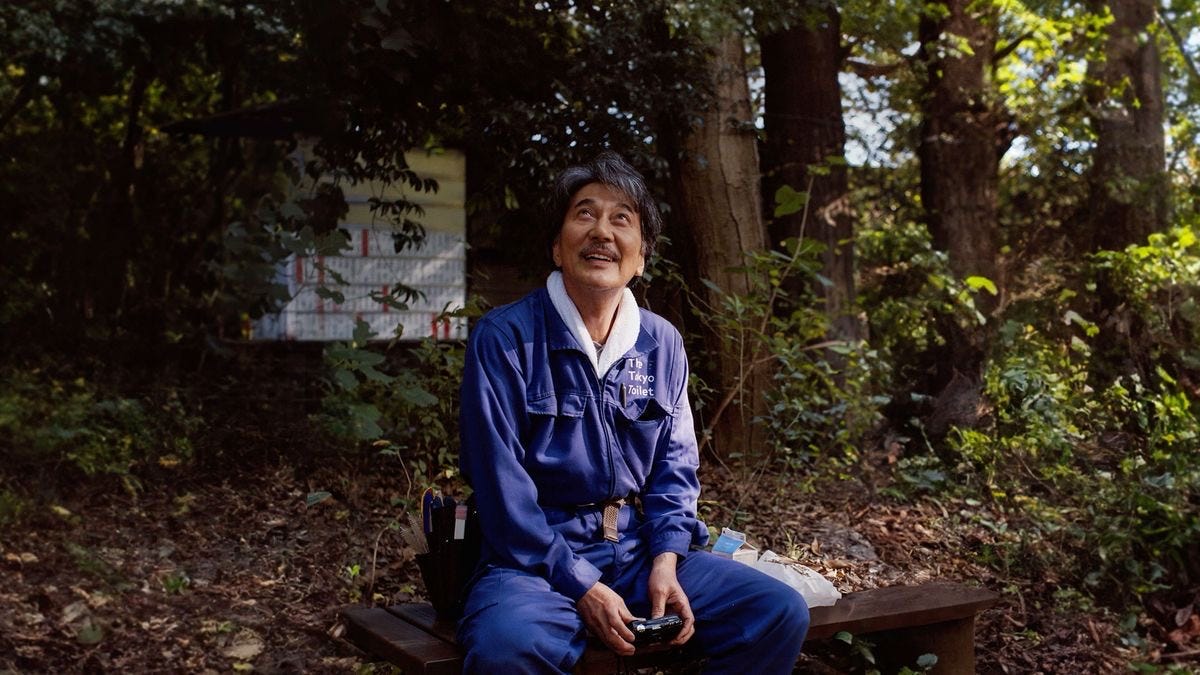
I recently watched the movie Perfect Days, and as you can imagine if you’ve seen it, it became one of my instant favorite films of all time. It combines everything I love: meaning in simplicity, Japan, trees, good music, the magic of a slow life.
The main character, Hirayama, lives what would be seen by most people as a very plain, boring life: he works as a toilet cleaner and has the same routine every single day, with nothing that you’d call “exciting” happening in his days. But he has a perfect day almost every day. Because within the mundanity of his life, he is someone who engages so deeply with every single thing he does. He notices every detail, is fully present in every moment. He drives to work listening to his favorite music every morning (really listening), engages with his hobbies and passions regularly, and treats his work with his full attention instead of seeing it as something to just be done with as soon as possible. He spends his lunch breaks simply looking up at the trees, and really seeing the light flicker among their leaves, the dancing shadows they create.
This film introduced me to the word komorebi, describing sunlight leaking through the tree leaves. It’s something so genuinely beautiful and so omnipresent, yet how often do most people stop to really look at it, to pay attention, find awe in it and take it in?
A few years ago, I became interested in Albert Camus’ absurdism. I found his theories freeing: he recognises that we are meaning-seeking creatures, and argues that since the universe doesn’t provide any of the answers we’re looking for about why we’re here or what the grand purpose our life is, the best thing we can do is to live vividly in the midst of that inherent paradox anyway. By seeing the universe as indifferent and thus accepting that there might be no higher meaning for us to seek, Camus argues that the best thing we can do is to be as present as possible in the here and now, where real meaning and aliveness is actually generated.
Absurdism forces us to face the fact that it’s easy for us to delay being present until we reach some “perfect'“ circumstance, but that may never come – so we have to live fiercely now, to find all the meaning we can in the mundanity that life offers.
When Camus writes “one has to imagine Sisyphus happy” as he faces his punishment of pushing that rock up the hill only to keep doing it over again for eternity, I think we have to imagine him stopping at the top to admire the view every time, to pay attention to the shadows around him and notice how they may have changed. It reminds me of Dostoyevsky’s existentialism in White Nights, and the way that for him, meaning in times of difficulty is found in beautiful things that come and go: “My God, a moment of bliss. Why, isn’t that enough for a whole lifetime?”.
In Perfect Days, our main character and his new friend wonder: Do shadows get darker when they overlap? They test it out with their own shadows and find out that they don’t. Hirayama goes “this is complete nonsense.” And then, immediately, the two of them start playing a game and jumping around, chasing each other’s shadows like kids. To me, that scene encapsulated perfectly what is so beautiful about the film: there doesn’t need to be a meaning to everything; very often, it just is what it is. The best thing we can do is to have fun with the absurdity of it all, to pay enough attention to what’s right in front of us to see it in its fullness.
Our life is shaped by what we direct our attention to. No matter how beautiful one’s life looks from the outside, it won’t feel that way if they don’t linger enough to pay attention to what is right there. The most mundane, slow life can feel like the most perfect one in the world if we stop seeking awe and meaning in something grandiose and elusive, and realize that it’s always been right there.

Join 65,000+ Crystal Clear readers as a free subscriber for essays that shift how you think, or upgrade to a paid subscription to join our Crystal Clear Club, where you receive practices that shift how you live, monthly live discussions, and a like-minded community in 190 countries around the world! ✧
Oh dear ! you spoke directly to my soul... awe is how our soul taps us on the shoulder... reminds us it's still there, still feeling things alongside us, not just filing away the days. Thank you for this gem you shared with us. Loved it.
I loved this sm, reminds to enjoy every ordinary moment as didion says “Every day is all there is.”